I Don't Care. You're Hungry.
Travel Stories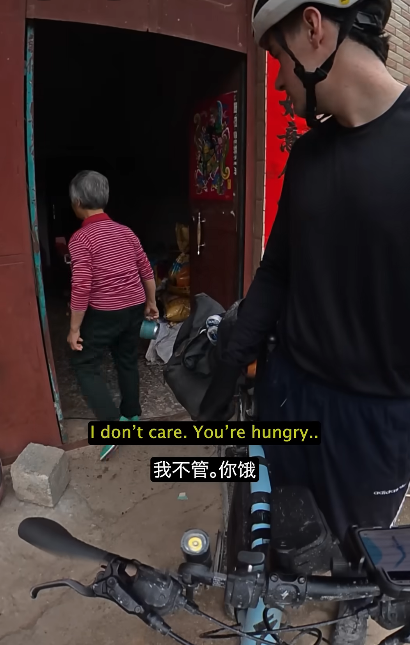
In March 2026, an American cyclist named Jack Mullinkosson was riding alone through rural Guangxi. He had traveled over 70 kilometers that day. He had no food left. No stores in sight. Just mountains and rice paddies stretching in every direction.
At some point, he drifted off the main road. He found himself in a small village. An elderly woman was working in her yard when she noticed him. She called him over and offered him water. Then she asked if he wanted to eat.
He hesitated. He was hungry. But he didn’t want to be a burden. He told her he didn’t want to trouble her.
Her response was simple. She turned and walked toward her kitchen, then said something that would stay with him:
“I don’t care. You’re hungry.”
It wasn’t an invitation. It was a command. She wasn’t asking. She was telling.
He followed her inside.
Her husband, hearing the commotion, walked over to the stove. He brought water to a boil, sliced fresh pork into the pot, and went out to the garden to pick a handful of pea shoots. A bowl of steaming rice, topped with pork and broth, was placed in front of him.
He ate everything.
When he tried to wash the dishes afterward, they wouldn’t let him. “Sit. Rest,” they said. They just wanted him to feel at home.
Before he left, Jack gave them a small bag of tea he had been carrying. It was all he had to offer. He told them if they ever visited America, they would have a place to stay.
That video has since been viewed over 4 million times. In it, Jack says:
“When you’re on a long solo ride, a stranger’s smile is like food for the soul. It makes the loneliness disappear.”
A Story That Stays With You
I watched this video three times. The first time, I smiled. The second time, I paused at the line: “I don’t care. You’re hungry.” The third time, I sat with it for a while.
That line is not a polite offer. It’s not a scripted kindness. It’s direct, almost blunt — the kind of bluntness that only comes from someone who genuinely doesn’t care about anything except that you are hungry. The tone says: You’re in my village. You need to eat. This is not up for discussion.
I think that’s what makes it so powerful. There’s no negotiation. No “if it’s not too much trouble.” No “are you sure?” Just: I don’t care. You’re hungry.
The second moment that stayed with me was the husband going out to the garden to pick pea shoots. Not leftovers. Not whatever was in the fridge. Fresh from the ground. A Chinese farmer in his seventies, cooking from his own garden for a foreigner he’d never met, and probably never would meet again. He gave him the best he had.
The third moment was the goodbye. Jack gave them a bag of tea. He said: “If you ever come to America, you have a place to stay.” It’s a small sentence, but it’s heavy. One foreign cyclist, one old couple, a shared meal in a village most people have never heard of. That connection is real.
A few days later, a reporter asked the woman — her name is Wei Fengxian, she is 72 years old — why she did it. She said:
“Travelers get into trouble sometimes. I couldn’t just stand by. Chinese people have always been hospitable. Anyone would have done the same.”
She’s wrong about one thing. Not everyone would have done the same. There’s a reason this video got 4 million views. Because the version of China people saw in it is not the version they expected. And the version of kindness they witnessed is not the version they’re used to.
I shared this video with a friend in London. He watched it, then said: “If that happened in my country, no one would open the door.” I told him I think he’s probably right. But also that maybe that’s exactly why this story needs to be told.
Story by YOGOTOCHINA
Based on the real experience of cyclist Jack Mullinkosson in Guangxi, China, March 2026.
✦ Ready to explore China?
Find your tour →